
The difference between sweaters, sweatshirts, hoodies, and jackets is largely in the form, but also in the formality. While each of these garments is handy at keeping us warm in the colder months, there are differences between each that make some better for casual situations, and some better for more formal gatherings.
I love the onset of fall and the colder months for one reason above all others: it’s time to break out the midlayers.
Women Hot Drill Sweatshirt Casual Long Sleeve Hoodie Comfy Trendy Solid Color Spring Fall Pullover

Sweatshirts, jackets, sweaters, and hoodies provide the appropriate warmth for the changing of the seasons, and also bring a ton of new outfit options.
I’m a big jacket guy, honestly to a fault. I used to throw a jacket over a t-shirt for activities as diverse as going grocery shopping, dinner with my in-laws, drinks with friends, or camping.
In my freshman year of high school, I wore the same jacket to school every day and wore it all day for six months straight. See what I mean? Big jacket guy.
At some point, I realized I was depriving myself of the joys of other midlayers, but didn’t exactly know where to start. Sweatshirts, sweaters, and hoodies all played the same role in my mind, so how would I decide which garment to wear, and when?
I’m sure I’m not the only guy who’s considered his wardrobe with the same question, so I did some research to help define the best time to wear each of these midlayers.
In this article I’ll define what each midlayer is and how to style it so you can expand your outfit options and not wear the same thing for six months like I did.
Sweatshirt vs Jacket vs Sweater vs Hoodie: Key Attributes

Speaking broadly, the main difference between these garments is the material they’re made from.
Let’s start with jackets, because of my aforementioned obsession.

Jackets can be made from almost any fabric, but the most common materials are cotton, wool, leather, polyester, and shearling. These garments represent a broad category of midlayers that encompass some of the other styles in question, like zip hoodies.
The most defining attribute of a jacket is the front closure, which often takes the form of a zipper or buttons. This is why zip hoodies are often considered jackets, but pullover sweatshirts aren’t.

Sweaters are another broad category, but are most commonly made from wool, cashmere, and synthetic materials. These garments are generally knitted or crocheted, which is their main difference from sweatshirts.
Based on the definition I gave above for jackets, sweaters with a front closure, like cardigans, can also be considered jackets.

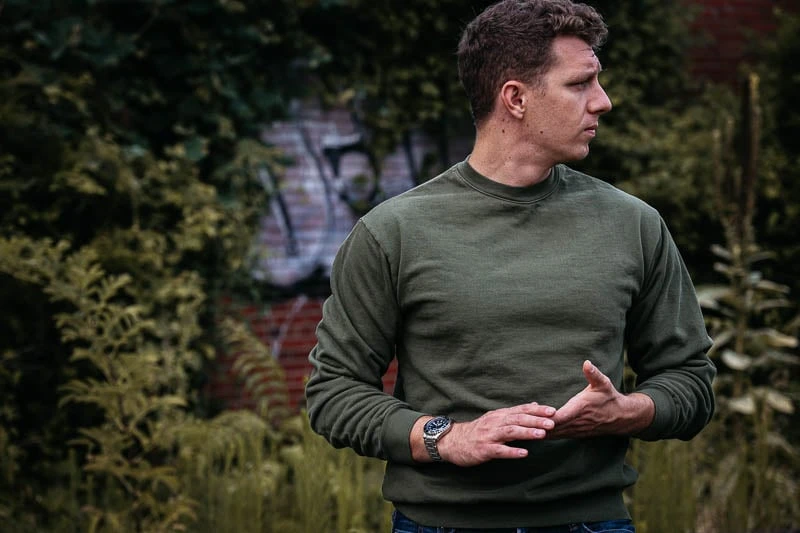
Sweatshirts are almost always cotton cloth material, and this term encompasses hoodies as well. Hoodies are sweatshirts, but not all sweatshirts are hoodies.
To make all these differences more clear, I’ve set up a table below to describe the attributes of each garment type for quick reference:
| JACKET | SWEATER | SWEATSHIRT | HOODIE | |
| Typical Fabrics | Cotton, wool, leather, polyester, shearling | Wool, cashmere, synthetic materials | Cotton, polyester, sometimes cashmere | Cotton, polyester, sometimes cashmere |
| Defining Features | Front closure (zipper or buttons) | Knitted or crocheted | Cotton cloth construction | Hooded and often has a kangaroo pouch |
| Hood? | Sometimes | No | Sometimes | Yes |
| Uses/Formality | Casual, semi-casual, semi-formal, camping, athletic wear, rainy conditions | Semi-casual, semi-formal, formal | Casual, loungewear, athleisurewear, camping | Casual, loungewear, athleisurewear, camping |
| Construction | Seamed | Seamed or seamless | Seamed | Seamed |
| Part of Another Category? | No | Yes, sometimes sweaters are jackets | Yes, sometimes sweatshirts are hoodies | Yes, hoodies are sweatshirts and sometimes jackets |
What Is a Sweater?

A sweater is generally a knitted or crocheted garment that has long sleeves and covers down to the waist. One notable exception to this is the sweater vest, which is an unfortunate addition to the annals of apparel history.
Sweaters come in all shapes and sizes, and often feature different textures due to the fact that they’re knitted and crocheted.
For example, cable-knit sweaters, ribbed sweaters, and regular knitted sweaters are some of the different textures you’ll frequently find in this garment category.
Besides textures, sweaters can be grouped into three main categories: pullovers, turtlenecks, and quarter-zips.

A pullover sweater is probably what first comes to mind when you think of a sweater. It has a crew neck and no front closure, meaning you have to pull it over your head to get it on. These sweaters have the same form as basic sweatshirts, but are made with different materials.
Turtlenecks are technically pullovers, in that you have to put them on the same way, but they have a raised collar that folds over. These add a subtle flair to any outfit and take some confidence to pull off well.

Lastly, we have quarter-zips. These are a cross between pullovers and turtlenecks. You have to pull it over your head to get it on. It has a raised collar, but it also has a zipper that goes down to the mid-chest, or a quarter of the way down your torso.
How Do You Style a Sweater?
There are endless ways to style sweaters, but I’ll cover some basics so that you can dress with confidence.
First, let’s start with a crew neck sweater. Find one of these that fits you well and is made with high quality material, and pair it with dark wash jeans and leather boots for a classic outfit that will never go out of style.
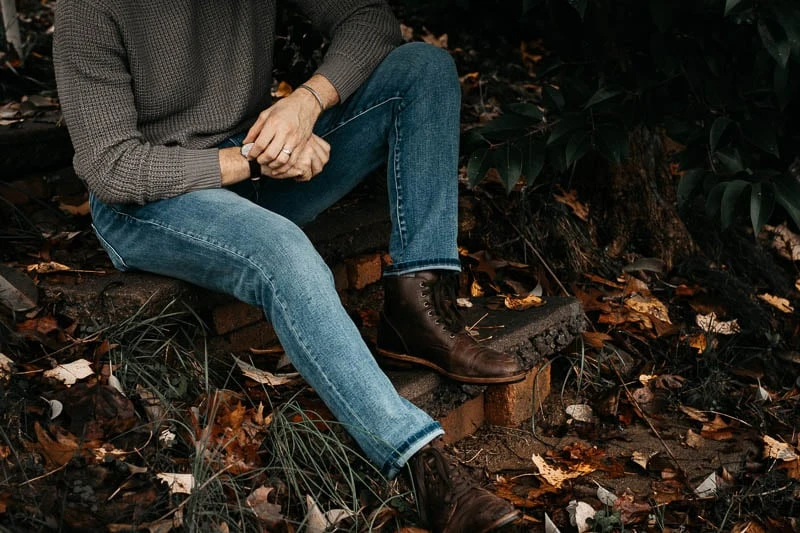
One of my go-to outfits is a cream or off-white sweater, a pair of dark blue jeans, and dark brown leather Chelsea boots. This kind of outfit is great for hanging with friends, appropriate for drinks on the town, and even a solid first date outfit if you dress it up slightly with a nice watch.
You can dress this outfit up even more by swapping out the jeans for chinos, and even further by layering a button-down shirt beneath the crew neck sweater.

This is also a great place to use quarter zips. Starting with Chelsea boots or your favorite pair of derbys, keep the chinos, keep the button-down, and put a quarter zip over top. You’ll look like you walked straight out of a J. Crew catalogue.
This is a great outfit for more formal work environments, a fancy dinner date night, and really any semi-formal occasion you can think of.
Lastly, we have turtlenecks. These are awesome for layering under a suit if you’re trying to hit that European, sleek look. Just make sure you wear suit pants that don’t require a belt—turtlenecks with a suit and a belt is a big no-no.

Speaking of turtlenecks with belts, unless you really love Steve Jobs I advise against wearing tight turtlenecks with jeans.
It can be done, but if you’re planning on tucking the turtleneck in you might as well throw out all your shoes and only wear white New Balance’s dads around the world are inexplicably drawn to.

If I’m wearing jeans or corduroys, I’ll wear a chunky, loose turtleneck over top for a casual, cozy look. Pair this with some leather boots and you’re ready for any casual weekend activities in style.
What Is a Sweatshirt

A sweatshirt typically has the same form as a sweater, meaning that it’s a pullover garment with long sleeves that covers down to your waist. Many exceptions to this exist, though, which we’ll get to shortly.
The defining characteristic of a sweatshirt is the material it’s made from. Sweatshirts are almost exclusively made from a heavy, cotton cloth material or polyester blend.
 French
  English
  Dutch
Dutch  German
  Italian
  Japanese
  Polish
  Russian
  Spanish
  Swedish